
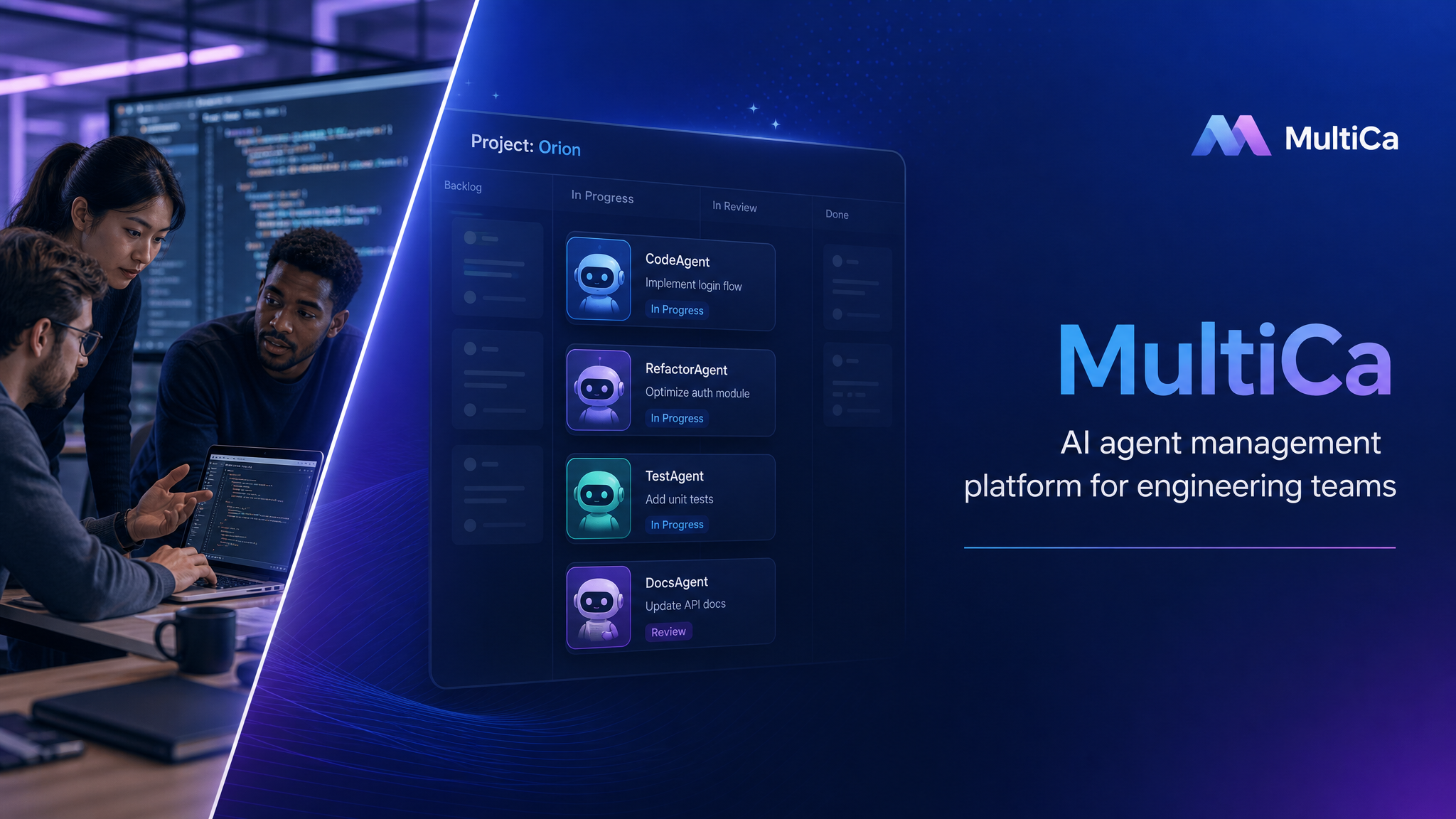
MultiCa: Turn AI Coding Agents Into Real Teammates

MultiCa: Turn AI Coding Agents Into Real Teammates

Your Next 10 Hires Might Not Be Human

By 2026, 22% of production code is AI-authored. Devin hits a 67% PR merge rate. Individual AI coding agents are undeniably production-ready.

But when you zoom out from the individual agent to the team, a different picture emerges. Faros AI's 2025 research found that high-AI-adoption teams merged 98% more PRs β€” but spent 91% more time on PR reviews. More code, same bottleneck.

This is the AI productivity paradox: individual agents are powerful, but a team of agents without coordination is chaos.

Enter MultiCa.

What Is MultiCa?

MultiCa (Multiplexed Information and Computing Agent) is an open-source managed agents platform β€” the first project management system purpose-built for human + AI teams. With over 22,000 GitHub stars, it transforms coding agents from isolated command-line tools into genuine team members with profiles, assignments, timelines, and accountability.

Think of it as Linear x LangGraph β€” but the agent execution layer is delegated to whatever CLI is installed on your machine (Claude Code, Codex, GitHub Copilot CLI, OpenClaw, OpenCode, Gemini, Cursor Agent, and more). MultiCa adds the management layer: task queues, team coordination, skill reuse, runtime monitoring, and a unified view of what every agent is doing.

The Problem MultiCa Solves

1. The Knowledge Wipe

When you throw a complex development task at a group of agents, they frequently fall into a state of self-indulgent chaos. Agent A painstakingly figures out the AWS deployment β€” but when Agent B takes over tomorrow, it steps on exactly the same pitfalls all over again. No knowledge transfer. No experience accumulation.

2. Agents as Tools, Not Teammates

Most teams treat AI coding agents like fancy autocomplete. That is the equivalent of hiring ten engineers and making each one work in a locked room with no Slack, no Jira, and no standups. The individual output is fine. The team output is chaos.

3. Code Volume Without Throughput

AI can write code at unprecedented speed, but the bottleneck shifts to review, merge, and architectural consistency. Without a coordination layer, more code just means more chaos.

How MultiCa Fixes It: Agents as First-Class Teammates

In MultiCa, agents are first-class teammates. They have profiles, show up on the board, post comments, create issues, and report blockers proactively β€” just like their human colleagues.

  • Assign Issues to Agents β€” Pick an agent from the assignee dropdown, just like you would assign a ticket to a developer. The agent picks it up, executes autonomously, and updates the status.
  • Autonomous Execution β€” Set it and forget it. Full task lifecycle management (enqueue, claim, start, complete/fail) with real-time progress streaming via WebSocket.
  • Real-Time Visibility β€” Watch agents work in real time, or check in whenever you want. The timeline is always current. Agents report blockers proactively.
  • Reusable Skills β€” Every solution becomes a reusable skill for the whole team. Deployments, migrations, code reviews β€” skills compound your team's capabilities over time instead of evaporating after each run.

Core Features

Agent Profiles

Dedicated profiles for each agent with task history, skills, and activity timeline

Task Board

Unified board showing all tasks across human and AI team members

Skill System

Successful task patterns automatically abstracted into reusable skill templates

Unified Runtimes

One dashboard for all compute: local daemons, cloud runtimes, auto-detection of available CLIs

Multi-Workspace

Organize work across teams with workspace-level isolation

Real-Time WebSocket

Live progress streaming, proactive blocker reporting

CLI Support

Claude Code, Codex, Copilot CLI, OpenClaw, OpenCode, Hermes, Gemini, Cursor Agent, Kimi, Kiro CLI

The Name: A Nod to History

The name MultiCa is a nod to Multics, the pioneering operating system of the 1960s that introduced time-sharing β€” letting multiple users share a single machine as if each had it to themselves. Unix was born as a deliberate simplification of Multics: one user, one task, one elegant philosophy.

We think the same inflection is happening again. For decades, software teams have been single-threaded β€” one engineer, one task, one context switch at a time. AI agents change that equation. MultiCa brings time-sharing back, but for an era where the "users" multiplexing the system are both humans and autonomous agents.

Like Multics before it, the bet is on multiplexing: a small team should not feel small. With the right system, two engineers and a fleet of agents can move like twenty.

Quick Start

# macOS (Homebrew)
brew install multica-ai/tap/multica

# Linux/macOS (script)
curl -fsSL https://raw.githubusercontent.com/multica-ai/multica/main/scripts/install.sh | bash

# Windows
irm https://raw.githubusercontent.com/multica-ai/multica/main/scripts/install.ps1 | iex

# One-command setup
multica setup

The setup command configures your environment, authenticates with MultiCa Cloud, and starts the daemon β€” all in one step. For self-hosting, append --with-server to deploy a full local server.

MultiCa vs. The Status Quo

Task Assignment
Without Copy-paste prompts to each agent
With Assign issues via board
Progress Tracking
Without Watch terminal output manually
With Real-time dashboard
Knowledge Reuse
Without Each agent starts from zero
With Skills compound over time
Team Coordination
Without Agents work in isolation
With Unified board + timelines
Blocker Reporting
Without You discover problems yourself
With Agents report proactively
Human Oversight
Without Manual PR review chaos
With Structured review workflow

The Bottom Line

The future of engineering teams has already arrived. Your next colleagues may not be human β€” but that does not mean they should operate without structure.

MultiCa's answer is clear: do not treat agents as tools. Treat them as teammates. The value of management has never disappeared because of technological progress β€” it just changes form.

Whether you are a solo founder with a fleet of coding agents or a 50-person engineering team navigating the AI transition, MultiCa gives you the coordination layer you need to turn Agent chaos into real shipping velocity.

A small team should not feel small.

← Back to Blog

πŸ“– Related Articles

🦞
How to Deploy OpenClaw β€” Step by Step Guide
2026-05-01
🧩
Top 10 Must-Install OpenClaw Skills in 2026
2026-05-01
🎬
How Singapore Creators Use ChatGPT to Write 30 TikTok Scripts in 1 Hour
2026-04-28
πŸ“Έ
AI Product Photography for Shopee Sellers: Complete SG Guide
2026-04-25